Edge AI: Rewiring Industries for a Real-Time Future in 2025 – But what is it?
Edge AI: Rewiring Industries for a Real-Time Future in 2025 – But what is it?
The hum of machines in a factory, the pulse of a smart city’s traffic grid, the precision of a surgical robot—these systems thrive on split-second decisions. Edge AI is emerging as a transformative force with growing real-world applications across key industries. At NVIDIA’s GTC 2025, Chen Su, Senior Technical Product Marketing Manager, highlighted how edge AI empowers real-time decision-making across sectors such as healthcare, robotics, and manufacturing.
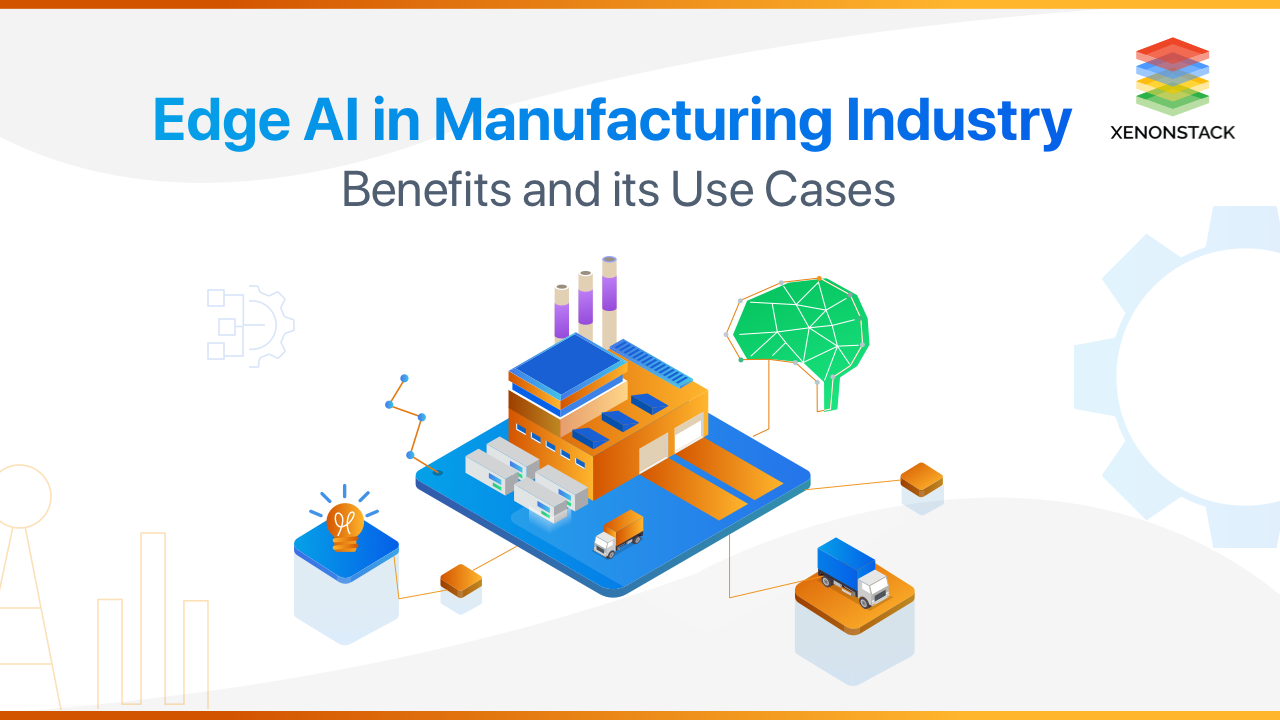
Image copyright Xenon Stack
This shift is influencing sectors such as manufacturing, healthcare, and smart city development, aligning with broader goals of efficiency and resilience. But as industries race to adopt this technology, they must navigate a labyrinth of challenges—hardware limitations, connectivity gaps, and ethical dilemmas—that could define the boundaries of progress.
Edge AI’s Transformational Shift
Edge AI flips the script on traditional data processing. Instead of shuttling data to distant cloud servers, it empowers devices—robots, sensors, cameras—to analyze and act instantly. This reduces latency, cuts bandwidth costs, and bolsters security by keeping sensitive data local. “The ability to process data at the source is a game-changer,” Su noted during his GTC session, emphasizing NVIDIA’s Jetson platform as a cornerstone for scalable AI deployment.
Consider manufacturing, where edge AI is a linchpin of Industry 4.0. Production facilities leverage autonomous systems to drive innovation, equipped with intelligent robots and digital twins—virtual replicas of physical systems—that can detect defects, predict equipment failures, and optimize workflows in real time. XenonStack emphasizes that edge AI enables predictive maintenance by analyzing sensor data directly on the factory floor, reducing latency and preventing unplanned downtime. In logistics, autonomous systems are increasingly deployed in warehouses to improve workflow efficiency—a trend supported by edge AI capabilities such as predictive analytics and sensor-based decision-making. These improvements boost efficiency and can contribute to reduced waste and energy use, which supports broader environmental targets.
Healthcare, too, is undergoing a quiet revolution. AI-powered medical imaging devices process scans on-site, flagging anomalies instantly. Telepathology, powered by edge AI, allows remote diagnoses with minimal delay, a critical factor in time-sensitive cases. According to XenonStack, processing at the edge reduces latency in medical diagnostics, allowing for faster, localized insights in healthcare.
A Network of Possibilities
The rise of 5G and 6G networks is amplifying edge AI’s potential. These high-speed, low-latency networks enable seamless communication between edge devices, creating interconnected ecosystems. Smart cities, for instance, leverage AI-driven traffic cameras to adjust signals dynamically, easing easing congestion and reducing emissions. In urban development, digital twins are increasingly used to model infrastructure projects, offering insights that help improve resource planning and operational efficiency. A Cognizant report from March 2025 highlights how telecom providers are using edge AI to deliver “AI-connected living,” integrating smart homes, factories, and cities into cohesive, responsive networks.
Image of Dr. Chen Su at GTC Copyright NVIDIA
Yet, the implications extend beyond operational gains. Edge AI is enabling faster operational response times, which may support competitive agility in industries such as manufacturing and logistics. As Vijay Anand, Vice President at Cognizant, noted, “Edge AI opens new revenue streams for telecoms and manufacturers, from predictive maintenance to personalized customer experiences.” This versatility positions edge AI as a catalyst for economic resilience, enabling industries to adapt to disruptions like supply chain shocks or regulatory shifts.
The Hurdles of Real-Time Intelligence
Despite its promise, edge AI’s path is fraught with obstacles. Hardware is a primary bottleneck. Edge devices must be compact, energy-efficient, and powerful enough to handle complex AI models. NVIDIA’s Jetson platform addresses this, but scaling such solutions across industries remains costly. Smaller factories, in particular, face barriers to entry, as software-defined infrastructures demand significant upfront investment.
Connectivity is another challenge. Many edge applications—think offshore oil rigs or rural agricultural drones—operate in areas with spotty internet. These environments require robust offline capabilities, which strain hardware and software design. “Decentralized processing is only as good as the infrastructure supporting it,” Su cautioned at GTC, underscoring the need for resilient edge architectures.
Security looms large as well. Localized data processing reduces cloud vulnerabilities but introduces new risks. Medical records, financial transactions, and industrial blueprints processed at the edge demand ironclad encryption and access controls. A single breach could erode trust in edge AI systems. Industries must also grapple with ethical questions. As AI makes autonomous decisions—say, prioritizing one traffic route over another—transparency and fairness become critical. Cognizant’s 2025 analysis urges businesses to adopt ethical guidelines, including regular audits and stakeholder dialogue, to mitigate societal impacts.
Legacy systems add another layer of complexity. Many factories rely on decades-old equipment, incompatible with modern AI frameworks. Integrating edge AI often requires retrofitting or wholesale replacement, a daunting prospect for cash-strapped enterprises. Data silos, where departments hoard information, further hinder cross-functional insights. Overcoming these barriers demands not just technology but cultural shifts within organizations.
Looking Ahead: Edge AI’s Next Frontier
Looking ahead, edge AI’s trajectory is increasingly intersecting with emerging technologies like generative AI, which is beginning to explore edge deployment for real-time personalization and analytics. Researchers are exploring how generative AI could support predictive maintenance by analyzing equipment data to forecast failures and optimize schedules. Researchers are also exploring how edge AI could integrate with building management systems to support more efficient energy usage. Digital twins are expanding in scope, with pilot programs exploring their use in broader operational modeling within smart factories and infrastructure.
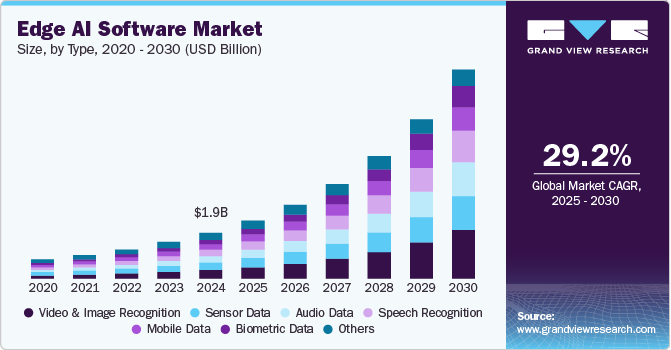
Image Copyright Grand View Research
The push for sustainability is another driver. Edge AI optimizes energy grids, balances renewable outputs, and reduces industrial waste. In food production, real-time quality checks catch contaminants early, minimizing recalls and environmental impact. Edge AI’s role in optimizing energy use and reducing waste may support broader environmental sustainability initiatives.
Building Resilience Through Edge AI
Edge AI is more than a technological leap; it’s a paradigm shift. By bringing intelligence to the point of action, it empowers industries to operate faster, smarter, and greener. Manufacturing ecosystems evolve into self-optimizing environments. Logistics networks turn agile, sidestepping global disruptions. Edge AI is helping cities become more responsive by enhancing infrastructure management and real-time services. Yet, the journey demands careful navigation. Hardware constraints, connectivity gaps, and ethical risks require collaborative solutions—between tech providers, industries, and policymakers.
As Chen Su concluded at GTC, “The edge is where the future happens.” For enterprises, the challenge is clear: embrace edge AI’s possibilities while addressing its complexities. Those who succeed will not only thrive in a real-time world but redefine what’s possible for industries and societies alike. As industries adopt real-time AI capabilities, edge computing is poised to anchor the next era of intelligent, real-time infrastructure.
More info here – Have a Story? Address it to the Editor and submit it here
Disclaimer
The information provided in this article is for general informational purposes only and from publicly available sources. While we strive for accuracy, we do not make any representations or warranties, express or implied, regarding the completeness, reliability, or validity of the content. This article does not make any direct claims about specific companies, individuals, or organizations. Any references to reports or external sources are for context and do not imply endorsement or verification of any specific allegations. Readers are encouraged to conduct their own research and seek professional advice before making business decisions. We disclaim any liability for any losses or damages incurred as a result of reliance on the information provided.