New IoT Battery-free AI enabled Standard developed by UK University Professors
New IoT Battery-free AI enabled Standard developed by UK University Professors
28 April 2025 | Newcastle, United Kingdom — An international team of scientists led by Newcastle University has achieved a historic breakthrough in sustainable technology: the development of a highly efficient, fully integrated indoor light-harvesting and storage system designed for autonomous Artificial Intelligence (AI) at the edge of the Internet of Things (IoT).
Published in the Royal Society of Chemistry journal Energy & Environmental Science (2025), the innovation represents a pioneering creation of an indoor-operating three-terminal photocapacitor, combining molecularly engineered photovoltaics, supercapacitors, and eco-friendly bio-derived membranes. This compact platform achieves a photocharging voltage of 0.92 V and an overall charging efficiency of 18% under standard indoor lighting (1000 lux) — a significant feat for battery-free energy systems.
In practical tests, the device powered edge AI CIFAR-10 image classification tasks at 93% accuracy, consuming just 0.81 millijoules per inference, and delivering throughput 3.5 times higher than conventional amorphous silicon-based indoor solar modules.
“This has been an idea brewing for almost a decade,” said Professor Marina Freitag, Chair of Energy Materials and Royal Society University Research Fellow at Newcastle University, who co-led the project. “To see it finally realised—not just as an academic prototype, but as a fully working system—is a tremendous milestone. It demonstrates what interdisciplinary, global collaboration can achieve in solving the sustainability challenges of intelligent technology.”
A Turning Point for Smart Sustainable Infrastructure
The importance of this development cannot be overstated. With projections of over 30 billion IoT devices by 2030, the need for sustainable, maintenance-free energy sources has never been greater. Traditional batteries pose significant environmental and logistical hurdles, including toxic waste and limited lifespans.
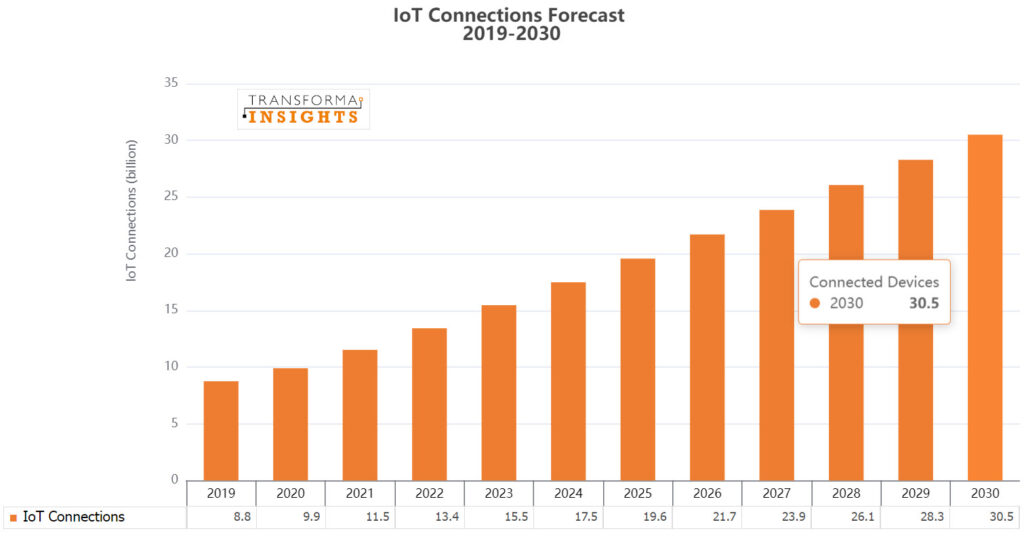
Image Copyright Information Matters
The Newcastle-led solution demonstrates a high-performance alternative for powering ubiquitous indoor IoT networks—supporting homes, hospitals, factories, and smart cities—without reliance on disposable batteries or wired connections. It directly contributes toward achieving United Nations Sustainable Development Goal 7 for affordable, clean energy.
Beyond environmental benefits, the technology lays the foundation for autonomous sensor networks capable of running AI locally, reducing data transmission loads and latency, and improving overall system intelligence.
How the New System Works: From Molecules to Machines
At the heart of the breakthrough lies a three-terminal ambient photocapacitor, integrating:
- A high-efficiency hybrid photovoltaic based on dye-sensitized solar cells (DSCs)
- A molecularly engineered polyviologen supercapacitor for energy storage
- Mushroom-derived chitosan membranes for sustainable ion transport
Together, these components allow the system to capture ambient indoor light and store it with minimal loss, achieving continuous energy supply for microcontrollers performing edge AI tasks.
In real-world validation, the photocapacitors powered a three-layer IoT network, executing machine learning inferences in a self-sustaining manner over 72 hours under standard room lighting.
The Open-Source System: PhotoCap Code
To complement the hardware, the team released the PhotoCap software platform as open-source under AGPL-3.0 licensing. This codebase powers the battery-free IoT network demonstrated in testing. It includes:
- L3_MnistDataSource: Simulates data acquisition nodes using MNIST (14×14 digits) for network demonstration
- L2_MnistComputeRelay: Receives data and executes local machine learning inference (e.g., MNIST or CIFAR-10 classification)
- L1_PidSleepRelay: Manages adaptive sleep cycles to conserve harvested energy efficiently
- L0_NrfFogRelay: Relays processed data to cloud servers via wireless links using nRF24L01+ communication
This multi-layer system allows decentralized IoT devices to perform real-time AI inference continuously, adapting their behavior based on available light energy — without needing batteries or a power grid. The main efficiency and energy tests utilized CIFAR-10 classification.
The repository is publicly available here: https://github.com/FreitagTeam/PhotoCap
International Collaboration Behind the Innovation
This landmark achievement was possible only through the efforts of an international, multidisciplinary team:
- Newcastle University (UK): Device engineering, photocapacitor integration (led by Prof. Marina Freitag and Dr. Natalie Flores-Diaz)
- University of Rome Tor Vergata (Italy): Supercapacitor integration and hybrid electronics expertise (Dr. Francesca De Rossi, Associate Professor Francesca Brunetti)
- Technical University of Munich (Germany): Device simulation and IoT system testing (Richard Freitag, Prof. Alessio Gagliardi)
- University of Naples Federico II (Italy): Theoretical modeling of molecular materials (Prof. Ana Belen Muñoz-García, Prof. Michele Pavone, Francesca Fasulo)
- EPFL Lausanne (Switzerland): Advanced material and device characterization (Prof. Michael Grätzel, Sandy Sanchez Alonso)
- Spanish National Research Teams: Biodegradable chitosan membrane development (Dr. Zaida Perez-Bassart, Dr. Amparo Lopez-Rubio, Dr. Maria Jose Fabra Rovira)
The project was funded by the EU Horizon 2020 Marie Skłodowska-Curie Actions, the UK Research and Innovation (UKRI EPSRC), the Royal Society, and the CETPartnership SPOT-IT project.
About the Lead Professors
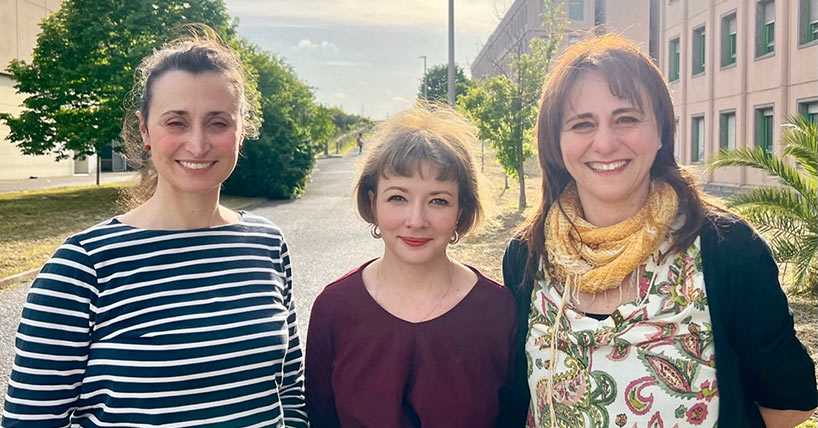
Photo: (l-r) Dr DeRossi, Prof Freitag and Prof Brunetti
- Professor Marina Freitag (Newcastle University, UK)
Chair of Energy Materials at Newcastle University and Royal Society University Research Fellow. She specializes in sustainable energy conversion, photocapacitors, and ambient IoT power systems. Prof. Freitag holds a leading position in the field of low-light photovoltaics and molecular energy engineering. - Dr. Natalie Flores-Diaz (Newcastle University, UK)
Marie Skłodowska-Curie Fellow specializing in device engineering and molecular solar energy systems. Previously trained at EPFL Lausanne, Dr. Flores-Diaz focuses on developing hybrid dye-sensitized solar cells for sustainable technologies. - Associate Professor Francesca Brunetti (University of Rome Tor Vergata, Italy)
A pioneer in supercapacitor development and hybrid electronic devices, Prof. Brunetti led the integration of energy storage components into the new photocapacitor architecture. - Dr. Francesca De Rossi (University of Rome Tor Vergata, Italy)
An expert in materials engineering and nanotechnology for energy systems, Dr. De Rossi drove the device assembly and performance testing efforts crucial for the system’s success.
Conclusion
This innovation by Newcastle University and its partners represents a defining step toward battery-free AI-enabled IoT networks. With sustainable light harvesting and intelligent energy management now viable under indoor conditions, the door is open for a new generation of self-sustaining smart infrastructure — powering homes, hospitals, industries, and cities with minimal environmental impact.
By merging world-class expertise across photovoltaics, molecular chemistry, materials science, and embedded AI, the team has set a bold new standard for the future of sustainable technology.
More info here – Have a Story? Address to the Editor here
Disclaimer
The information provided in this article is for general informational purposes only and is derived from publicly available sources. While every effort is made to ensure accuracy, we make no representations or warranties, express or implied, regarding the completeness, reliability, or validity of the content. This article does not assert or verify any claims about specific companies, individuals, or organizations. References to external reports, studies, or sources are for contextual purposes only and do not imply endorsement or confirmation of any specific allegations. Readers are advised to conduct their own due diligence and seek professional advice before making business or investment decisions. We disclaim any liability for losses or damages incurred as a result of reliance on the information provided.