Meta Showcase of Aria Gen 2 Research AR Glasses as competition heats up
Meta Showcase of Aria Gen 2 Research AR Glasses as competition heats up
Meta introduced the Aria Gen 2 earlier this year as the next phase in its research glasses lineup. While initial details were limited, the company has now begun revealing more information as it prepares to make the device available to third-party researchers next year—offering a preview of potential features for future AR eyewear.
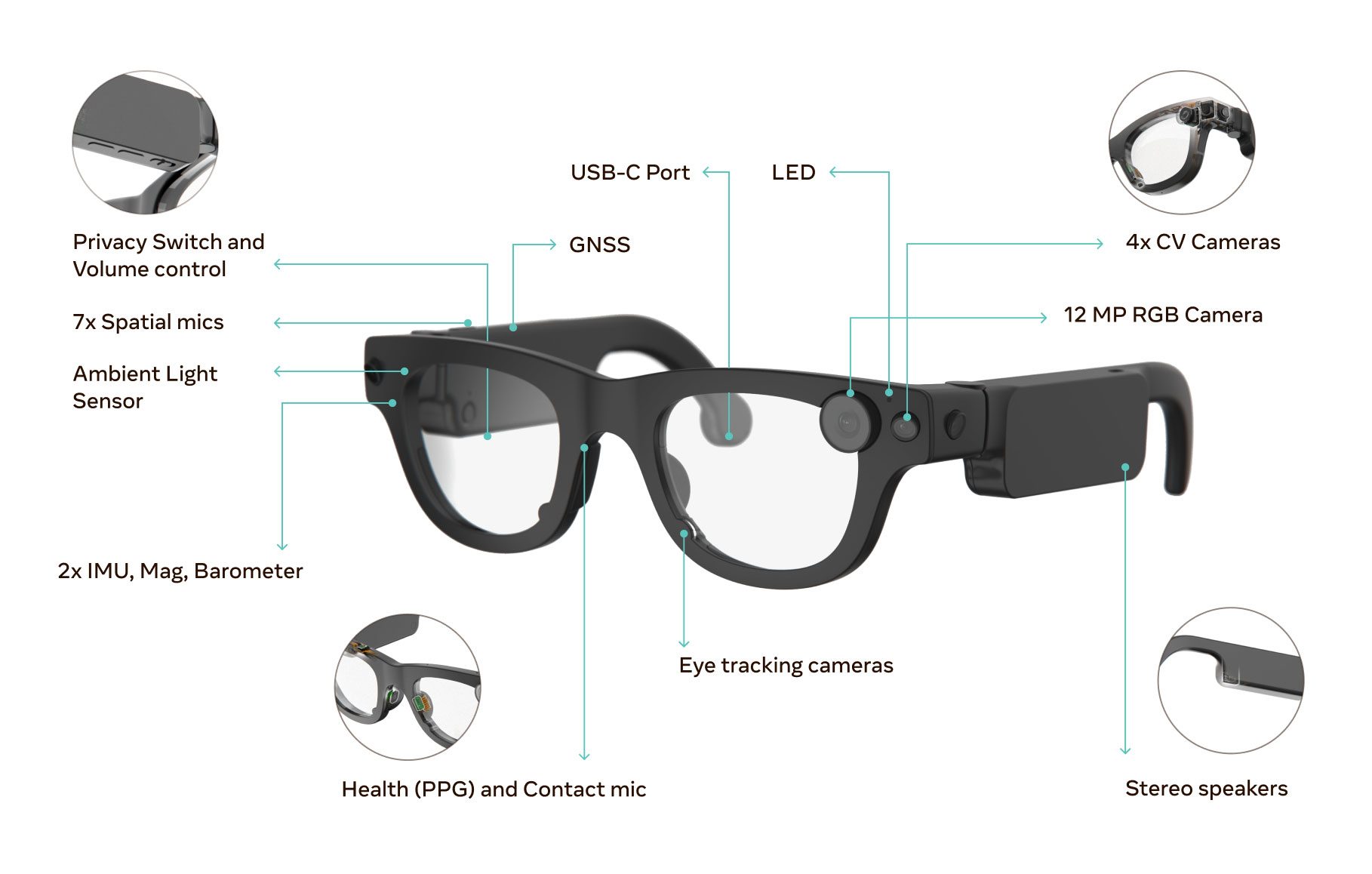
In a recent update, Meta shared specifics on Aria Gen 2’s structure, sensor suite, audio enhancements, onboard compute, and camera systems.
Although Aria Gen 2 does not include a display and therefore can’t deliver full AR capabilities, the technologies embedded in the device hint at what may become standard in future AR glasses.
Enhanced Computer Vision for Next-Gen AR
Future AR devices will depend heavily on strong computer vision systems capable of mapping spaces and identifying objects. Aria Gen 2 improves on its predecessor by incorporating four CV cameras—doubling the count from Gen 1—and includes a 120 dB HDR global shutter, expanded field of view, and 80° stereo overlap, which significantly improves 3D tracking and spatial perception.
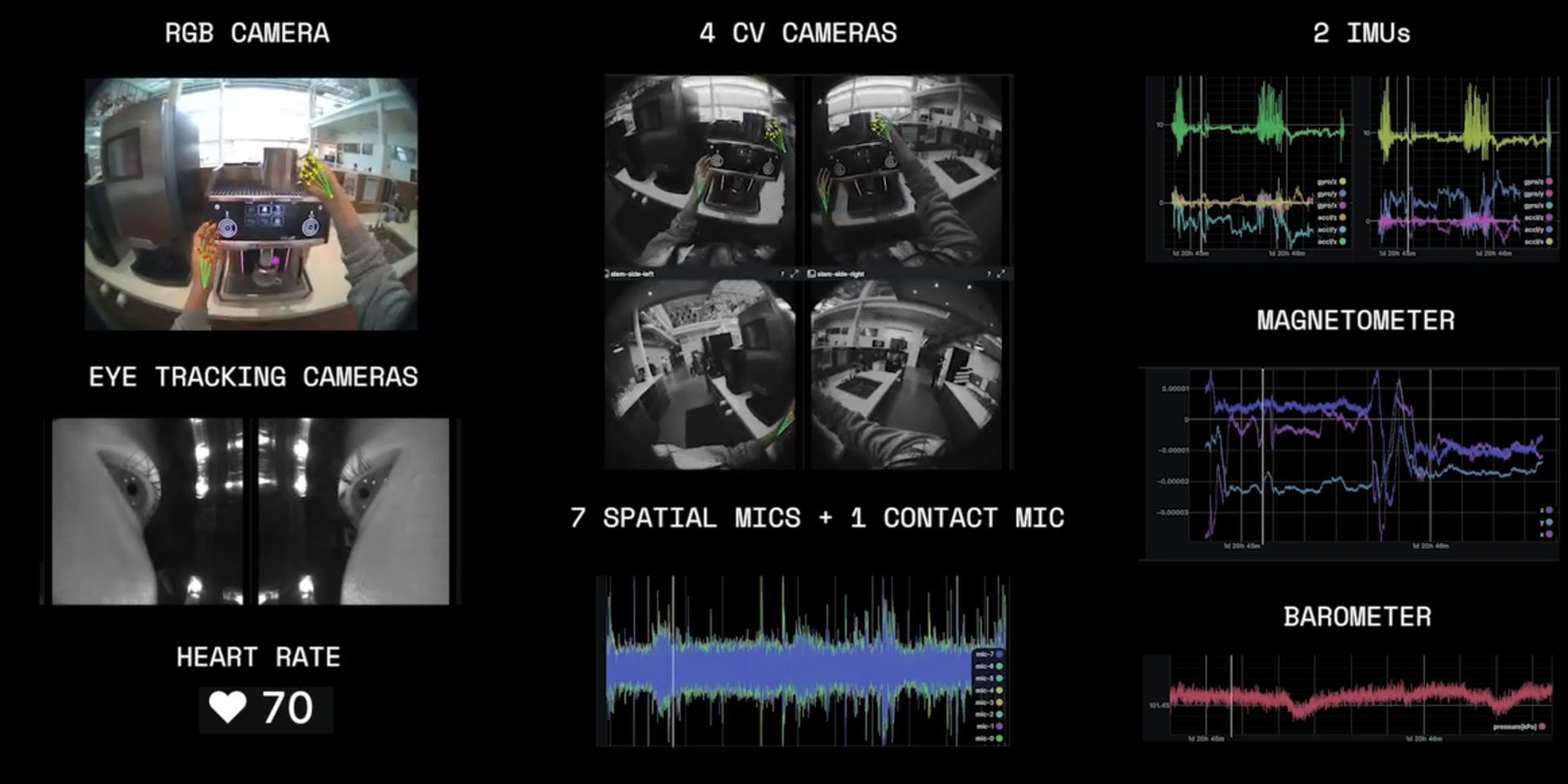
Meta demonstrated Aria Gen 2’s simultaneous localization and mapping (SLAM) in action, highlighting how it handles real-time environmental understanding.
Upgraded Sensors and Onboard Intelligence
The device also brings sensor advancements. These include a calibrated ambient light sensor, a heart rate monitor (PPG), and a contact microphone within the nosepad for better audio capture in noisy settings.
On-device processing power has been upgraded as well. Meta says Aria Gen 2 supports real-time machine perception through a proprietary coprocessor and can handle:
- Visual-Inertial Odometry (VIO) for six degrees of freedom tracking
- Sophisticated eye tracking (pupil size, blink rate, gaze, and vergence)
- 3D hand tracking for detailed motion capture
- SubGHz radio for sub-millisecond device synchronization in multi-device use
Lightweight and Wearable
Despite housing advanced capabilities, Aria Gen 2 weighs only 74–76 grams. By comparison, standard eyeglasses typically range from 20 to 50 grams depending on design and materials. Meta provides eight size options for better fit based on individual head and nose bridge dimensions. The glasses also fold for convenience, similar to regular spectacles.
Battery life details remain undisclosed, though a USB-C port on the right arm suggests potential tethering to an external power source.

Fusing Human and Machine Perception
Aria Gen 2 gathers environmental and physiological data, such as eye movement and heart rate, as seen in demonstrations involving everyday tasks like making coffee. The glasses track a user’s physical interaction with their surroundings using input from cameras, a magnetometer, dual IMUs, and a barometer.
These combined inputs provide rich data for human behavior research and could also serve as a foundation for future AR interfaces.

Laying the Groundwork for AR’s Next Phase
Meta believes that Aria Gen 2 is a foundational step toward developing the next generation of computing platforms, with AR at its core. However, widespread adoption of AR as a smartphone replacement may still be years away.
While some consumer AR glasses like the XREAL One Pro already offer displays and onboard processing, building lightweight devices with full-day battery life remains a significant challenge. Meta is also working on its Orion prototype, which connects wirelessly to a compute unit and may offer a more complete AR experience in the future.
Meta CTO Andrew Bosworth has stated that an Orion-based AR product is expected within this decade, potentially priced above today’s smartphones.
Meta plans to showcase Aria Gen 2 at CVPR 2025 in Nashville from June 11–15, offering interactive demos and further insights into the device’s capabilities.
More info here – Submit a story to “the Editor” here
Disclaimer
The information provided in this article is for general informational purposes only. While we strive for accuracy, we do not make any representations or warranties, express or implied, regarding the completeness, reliability, or validity of the content. This article does not make any direct claims about specific companies, individuals, or organizations. Any references to reports or external sources are for context and do not imply endorsement or verification of any specific allegations. Readers are encouraged to conduct their own research and seek professional advice before making business decisions. We disclaim any liability for any losses or damages incurred as a result of reliance on the information provided.